Lighting design
Lighting fixtures and light systems in which the form follows the required emission, colour temperature and beam distribution.
Method
First we define the light that is needed. The shape of the fixture comes afterwards, within those parameters. The order matters, and reversing it produces objects that light poorly.
Lighting design phases
1. Brief, positioning and research
analysis of the company brief, the brand’s positioning and the structure of the existing catalogue. Review of the lighting typologies already in the collection, the available light sources, the materials compatible with production and the power supply and control technologies. Assessment of electrical safety regulations, energy efficiency requirements, IP ratings and thermal constraints related to LED heat dissipation.
2. Formal concept
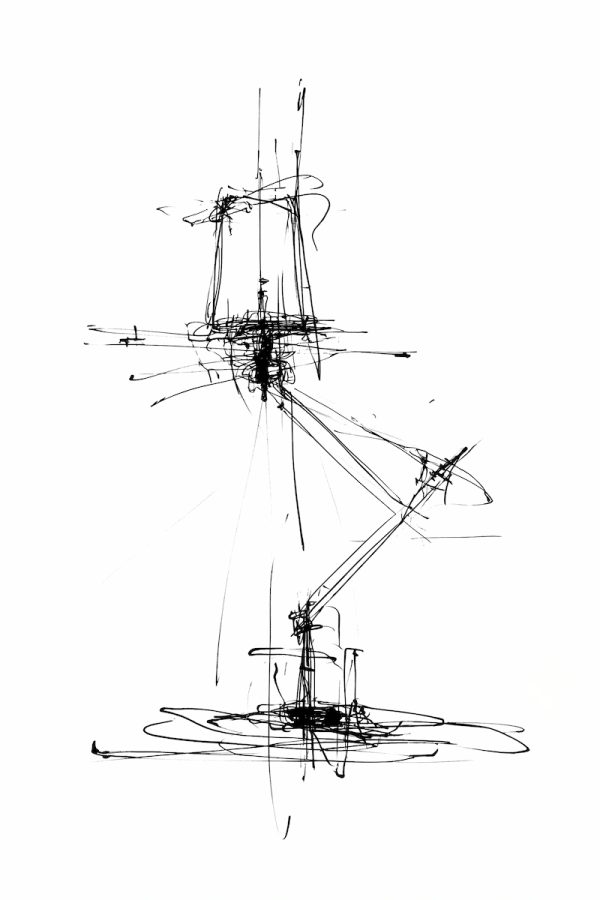
verification of the relationship between the luminaire body and the source, the logic of emission and the distribution of light in space through sketches, volumetric studies and three-dimensional modelling. Photometric simulations for the assessment of expected performance. Definition of materials, finishes and coherence with the existing catalogue.
3. Development and prototyping
production of working prototypes for the verification of luminous output, photometric distribution, colour temperature and thermal behaviour. Verification of proportions, material quality and construction precision alongside lighting performance. Correction and reproduction of the models until the required performance is achieved.
4. Engineering
preparation of the technical documentation for production with dimensioned drawings, bills of materials, electrical specifications, tolerances and assembly details. Verification, with the company’s technical departments, of compatibility with production lines, available electronic components and certification requirements.
5. Production supervision
control of pre-series samples, mechanical workmanship, surface finishes and lighting and regulatory compliance. Verification of electronic components, soldering, treatments and assemblies throughout the entire supply chain until final approval.
Scope of work
Pendant lights
ceiling-suspended fixtures for general or accent lighting. Definition of body geometry, suspension system, light distribution and dimensional relationship with the space below.
Table lamps
surface-mounted fixtures for task or ambient light, designed with attention to stability, weight, ergonomics of use and the quality of light cast onto the surface.
Floor lamps
stem-based elements for indirect, reading or ambient light, with definition of height, source adjustability, counterweight and floor footprint.
Wall lights
wall-mounted light points for accent, courtesy or perimeter lighting. The project addresses projection depth, beam angle and installation system.
Outdoor lamps
fixtures with IP ratings suited to outdoor installation, corrosion-resistant materials and surface treatments compatible with atmospheric exposure.
Lighting systems
modular structures, tracks, profiles and configurable systems that allow multiple arrangements from a single formal language. Definition of base elements, aggregation logic and dimensional variants within the range.
Architectural lighting
recessed fittings, step lights, LED strips and profiles integrated into architectural surfaces, where the source is integrated into the project and the work focuses on the quality of light in relation to the surrounding materials.
Vision
A lamp has two existences: switched off it is an object, switched on it is an instrument. We design for both.