DDN - December 2021
DDN devotes six pages of issue 271, December 2021, to the contemporary penthouse in Bologna under the title Luogo di vita e di emozioni, ‘a place of life and emotion’. Written by Luisa Castiglioni, the feature includes a biographical profile of Francesco Meneghello.
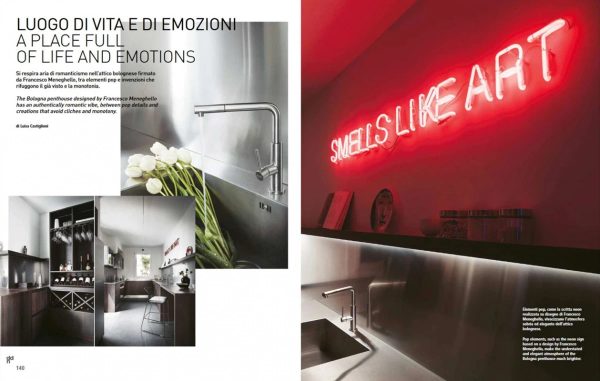
Design Diffusion News was founded in Milan in 1990 by the publisher Carlo Ludovico Russo. It covers furniture design, interiors and architecture for an international readership, and is published in Italian and English as part of Design Diffusion World. Issue 271, December 2021, takes an in-depth look at design from continental Europe. The feature on the contemporary penthouse opens on pages 140 and 141 with the kitchen’s SMELLS LIKE ART neon sign, made to a design by Francesco Meneghello. Glassworkers bend the tubes into letters by hand over a flame, then fill them with neon gas, which glows red when an electric current passes through it.
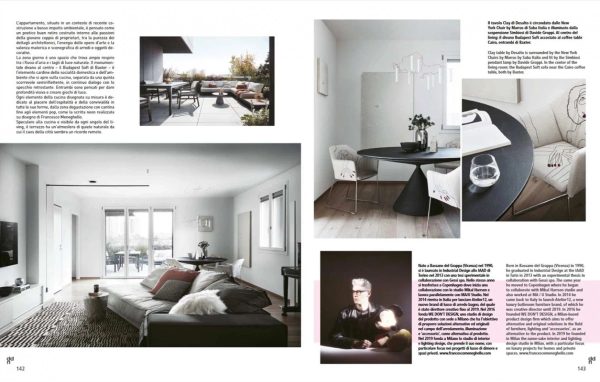
At the centre of the living room, the Budapest Soft sofa is paired with the Cairo coffee table, both designed by Paola Navone for Baxter. Budapest was Navone’s first sofa for the company. The Soft version has supple leather upholstery with raw-edge seams and goose-down cushions. Cairo is made of tinned brass, hammered by hand, with a pattern of facets that differs from one piece to the next.
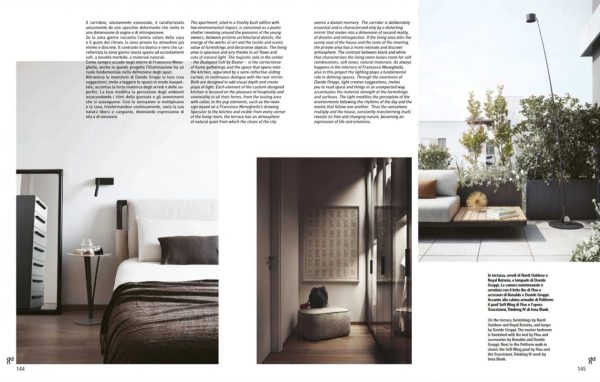
In the dressing room, behind the pouffe, hangs Irma Blank’s Trascrizioni, Thinking IV, as the magazine’s caption indicates. Born in Germany and active in Italy, Blank began her Trascrizioni series in 1973, transcribing pages from newspapers and books in ink. Her script retains their layout, with no legible letters or words. Gillo Dorfles described this practice as ‘asemantic writing’.